
Showing posts with label Train. Show all posts
Showing posts with label Train. Show all posts
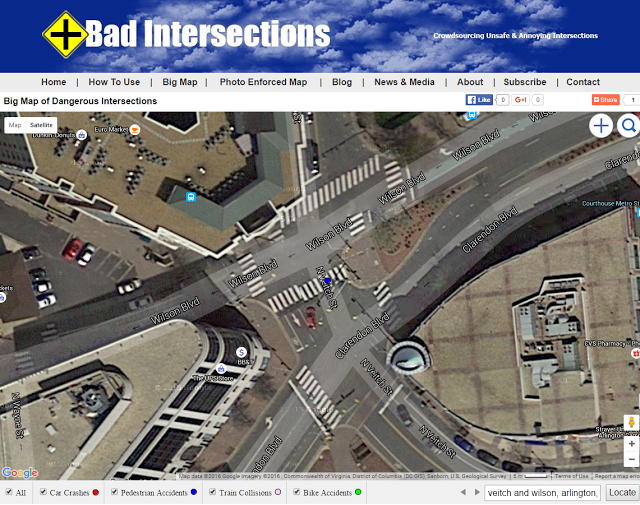
100's of Dangerous Train Intersections To Be Upgraded or Eliminated

Dangerous Train Intersections Map
The Biden administration has taken a significant step towards improving safety at railroad crossings throughout the United States by awarding $570 million in grants. Recognizing the importance of safeguarding public welfare and minimizing the potential risks associated with railway intersections, these grants will address critical issues to enhance overall safety measures.

What Is A Blind Intersection?

Here is an example of a blind intersection
The hill is blocking a view of oncoming traffic
According to the DMV’s Driver Handbook, “an intersection is considered “blind” if there are no stop signs at any corner and you cannot see for 100 feet in either direction during the last 100 feet before crossing. If your view is blocked, move slowly forward until you can see.”It also applies to where you can't see where traffic is coming from because obstacles like trees, buildings, cars could be blocking your view. Stop signs or other traffic signals are usually absent in such scenarios.
Traffic accidents are a serious public safety problem everywhere, but statistics show that more accidents occur on certain roads and at certain intersections. A frequently cited statistic is that 80% of all collisions involving injured or dead people in cities occur at signal-controlled, light-controlled intersections, according to the US Department of Transportation. The average speed at intersections in the city is often over 35 mph.
Badintersections.com has a database of dangerous blind intersections. Please add new blind intersections to our map here.
In most cities, there are many dangerous intersections with dangerous blind intersections. Poorly designed intersections can have blind spots that block the driver's field of vision and make it difficult to see oncoming cars. In some cases, motorists do not comply with the applicable laws and regulations on stopping at stop signs, even if they have stopped at a stop sign. A poorly designed intersection could have a blind spot that impedes a driver's field of vision and makes it harder for him to see oncoming vehicles, cyclists, and pedestrians.
The majority of collisions at stop-light controlled intersections happen within 4 seconds of a light change. You don't want to be in the intersection during that 4 seconds. However, if you don't immediately go when the light turns green, people behind you get irritable, yes? Try this defensive driving tip.
The first thing is to make sure you stopped in the right spot. Stop far enough behind the stop line that you can see it on the pavement in front of your car - this normally gives you 10-15 feet of space. When the light turns green, take your foot off the brake and let your vehicle start to creep toward the crosswalk.
Common sense tells you that crossing a controlled intersection with a traffic light is much safer,. However, be careful turning right on red-light and give pedestrians sufficient time to make calculated decisions about the safety of turning right and to ensure that pedestrians do not cross the road and oncoming traffic does not enter the dangerous junction. Look out for cyclists and pedestrians crossing the intersection in both directions while driving. They are legally allowed to enter the middle of the intersections and wait for cars to pass before passing them.
Note that some states, such as Arizona, require that unregulated intersections be treated as four-way stops and that you come to a complete halt before driving through. When you arrive at a junction where you want to turn right - to the left - and there is no other traffic in sight, do not follow the correct lane as you approach the junction.
In most cities, there are many dangerous intersections with dangerous blind intersections. Poorly designed intersections can have blind spots that block the driver's field of vision and make it difficult to see oncoming cars. In some cases, motorists do not comply with the applicable laws and regulations on stopping at stop signs, even if they have stopped at a stop sign. A poorly designed intersection could have a blind spot that impedes a driver's field of vision and makes it harder for him to see oncoming vehicles, cyclists, and pedestrians.
The majority of collisions at stop-light controlled intersections happen within 4 seconds of a light change. You don't want to be in the intersection during that 4 seconds. However, if you don't immediately go when the light turns green, people behind you get irritable, yes? Try this defensive driving tip.
The first thing is to make sure you stopped in the right spot. Stop far enough behind the stop line that you can see it on the pavement in front of your car - this normally gives you 10-15 feet of space. When the light turns green, take your foot off the brake and let your vehicle start to creep toward the crosswalk.
Common sense tells you that crossing a controlled intersection with a traffic light is much safer,. However, be careful turning right on red-light and give pedestrians sufficient time to make calculated decisions about the safety of turning right and to ensure that pedestrians do not cross the road and oncoming traffic does not enter the dangerous junction. Look out for cyclists and pedestrians crossing the intersection in both directions while driving. They are legally allowed to enter the middle of the intersections and wait for cars to pass before passing them.
Note that some states, such as Arizona, require that unregulated intersections be treated as four-way stops and that you come to a complete halt before driving through. When you arrive at a junction where you want to turn right - to the left - and there is no other traffic in sight, do not follow the correct lane as you approach the junction.
Dangerous Train Collision with Truck at Intersection

In Atwater, California a truck driver was nearly hit by the train after truck gets stuck on the tracks. An abc30insider captured the moment a train smashed through a truck in Atwater. The driver had just seconds to escape.
Here are some key points regarding train collisions with trucks at intersections:
Potential Causes: Train collisions with trucks at intersections can occur due to various factors, such as:
Failure to obey traffic signals: Trucks attempting to cross railroad tracks may fail to yield the right of way to an approaching train.
Inadequate warning systems: Insufficient or malfunctioning warning systems, such as malfunctioning gates, lights, or bells, can contribute to accidents.
Driver distraction: Distracted driving, such as using mobile devices or being inattentive, can prevent truck drivers from noticing or responding to train signals.
Mechanical failure: Mechanical issues, such as brake failures or steering problems, can make it difficult for trucks to clear the tracks in time.
Poor visibility: Limited visibility due to weather conditions or obstructed sightlines can make it challenging for truck drivers to see or judge the distance of an approaching train.
Safety Measures: To mitigate the risk of train collisions with trucks at intersections, various safety measures can be implemented:
Improved signage and road markings: Clear signage and visible road markings can help alert truck drivers to the presence of railroad tracks and the need to yield.
Advanced warning systems: Effective warning systems, including active warning lights, gates, and audible signals, can provide advanced notice to truck drivers about approaching trains.
Education and training: Providing training and education to truck drivers on railroad crossing safety and the importance of yielding to trains can help raise awareness and reduce accidents.
Collaboration between transportation authorities: Collaboration between transportation authorities, including road and rail agencies, can help identify high-risk intersections and implement targeted safety measures.
Dangerous Train Intersections

Dangerous Train Intersections According to the Federal Railroad Administration
Search the map for #FRA
Train and car accidents can vary widely depending on various factors such as location, traffic conditions, railway infrastructure, and driver behavior. The number of train and car accidents can also vary from year to year.
To obtain the most accurate and up-to-date information on train and car accidents, I recommend referring to reliable sources such as transportation safety agencies, railway authorities, or governmental organizations responsible for collecting and reporting accident data. These organizations often publish annual reports or maintain databases with statistics on train and car accidents.
For train accidents specifically, the Federal Railroad Administration (FRA) in the United States collects and reports data on railroad safety, including train accidents. Their website provides comprehensive information on train accidents and other safety-related data.
For car accidents, the National Highway Traffic Safety Administration (NHTSA) in the United States is a valuable resource. They collect and report data on motor vehicle crashes, including car accidents, providing detailed statistics and analysis on various aspects of road safety.